Entered the Electrical and Computer Engineering Course, Department of Industrial Systems Engineering, National Institute of Technology, Hachinohe College
$ load profile
[OK] profile.json
$ compile projects
[OK] fpga_piano.v
[OK] minesweeper_solver.c
$ render portfolio
$ echo "$WELCOME"
Welcome — enjoy the build 👋
█
Profile
Daichi Kumagai 熊谷 大智
Hello, I am Daichi Kumagai, a 3rd-year student at Institute of Science Tokyo. After graduating from National Institute of Technology, Hachinohe College, I am now a member of the Kise Laboratory and continue learning hardware design every day.
Contact
kumagai.d.1e80@m.isct.ac.jp
GitHub
github.com/kumagai0212
Background
Background & Certifications
Graduated from the Electrical and Computer Engineering Course, Department of Industrial Systems Engineering, National Institute of Technology, Hachinohe College
Transferred to the Department of Computer Science, School of Computing, Tokyo Institute of Technology
Joined Kise Laboratory
Applied Information Technology Engineer Examination (Spring 2025)
Fundamental Information Technology Engineer Examination (2024/7/12)
TOEIC 830 (2024/1/28)
Publications
Publications
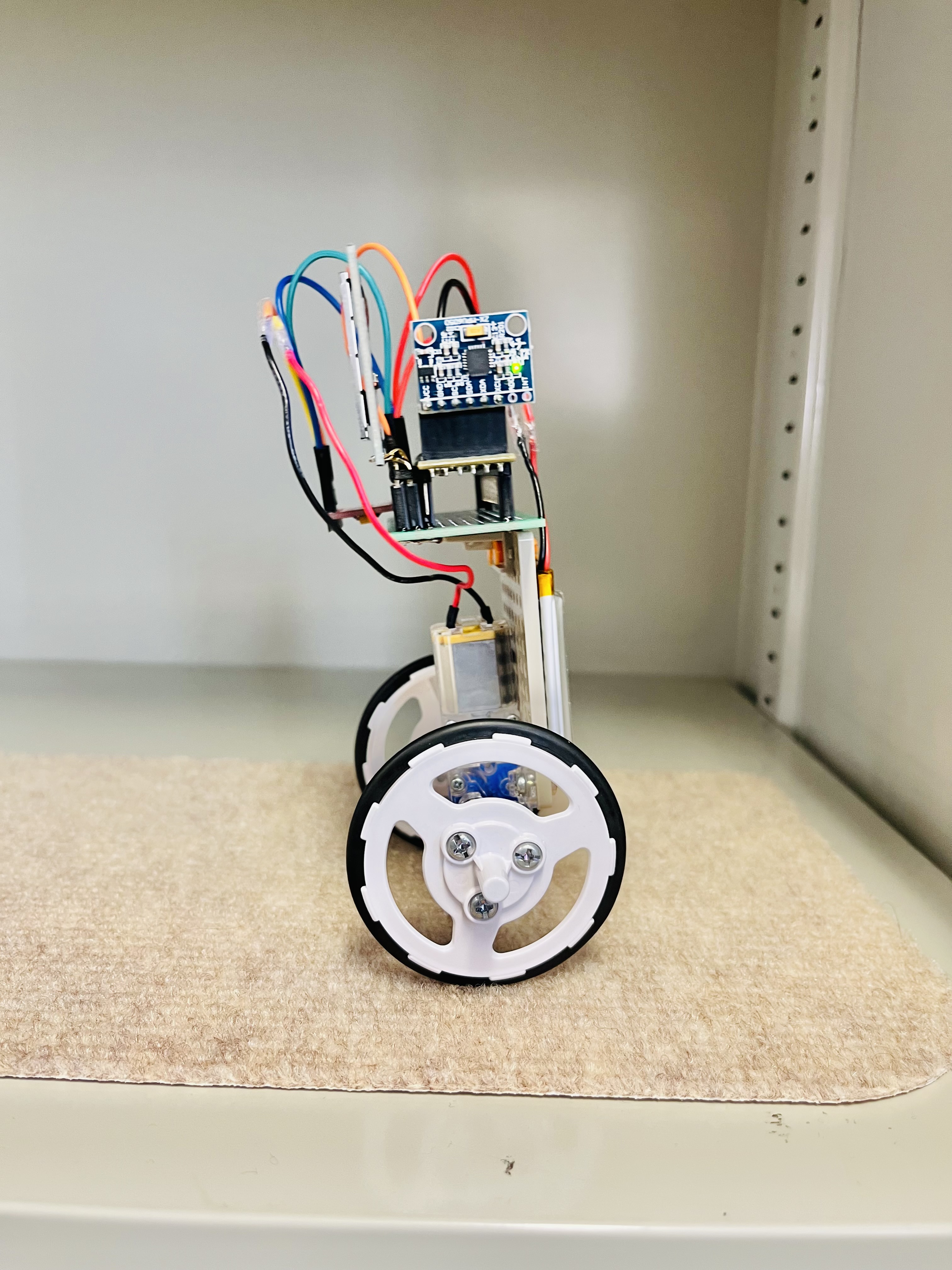
Robbit: A User-Friendly and Two-Wheeled Self-Balancing Robot Using an FPGA
Daichi Kumagai, Yuya Iwata, Komei Kodera, Kenji Kise
This work proposes “robbit,” a low-cost and user-friendly two-wheeled self-balancing robot using an FPGA. By using a RISC-V soft-core processor and the CFU Proving Ground framework, we designed and implemented it as an educational platform for learning hardware, gateware, and software co-design.
Publisher Link (DOI)Projects
Projects
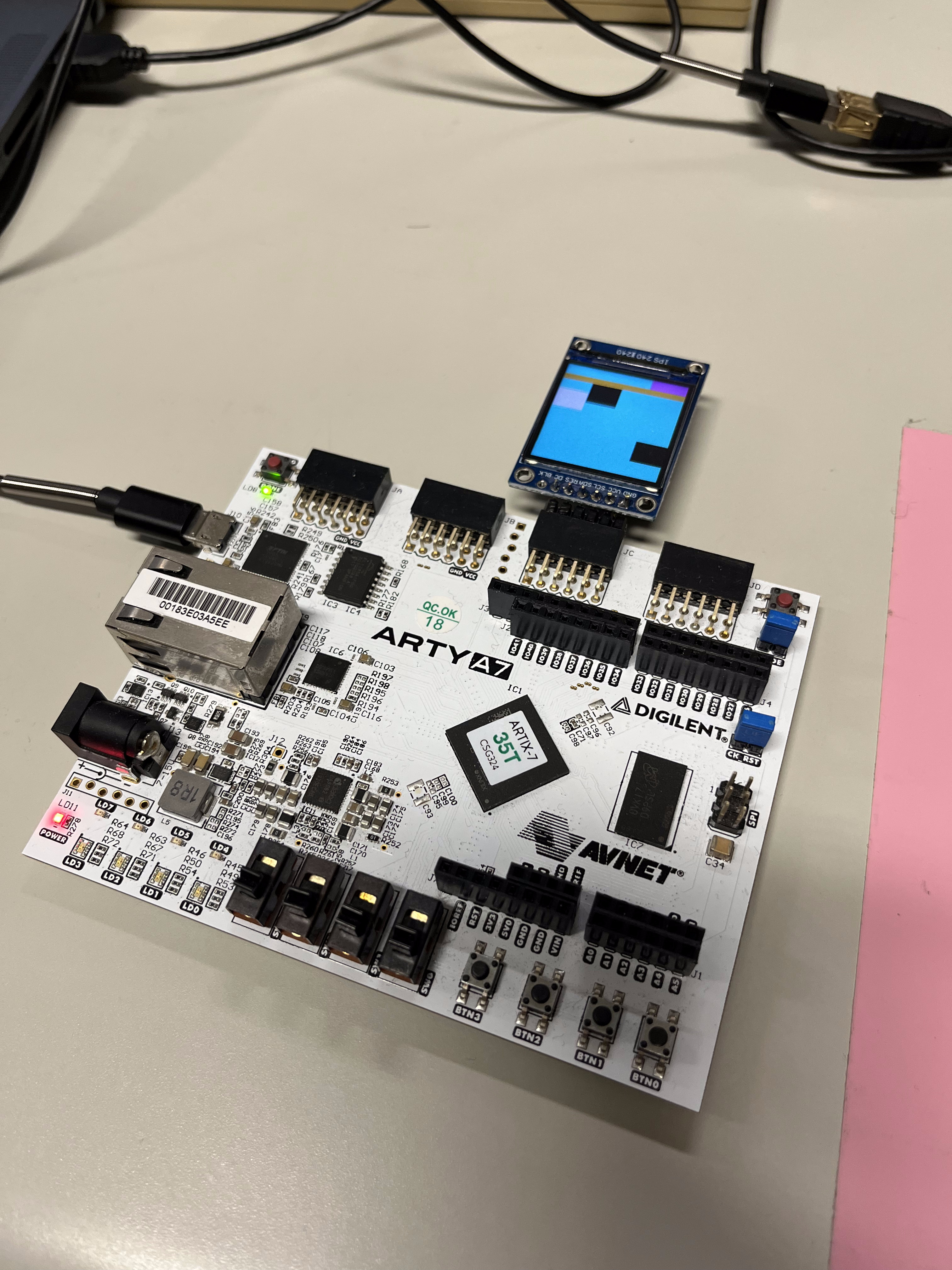
FPGA Piano Tiles
- Device: Digilent Arty A7-35T
- Language: Verilog HDL
- Peripherals: ST7789 (240x240 LCD), Tactile Buttons
FPGA Piano Tiles is a rhythm game running on an FPGA board. I implemented a game system where notes fall through four lanes and the player presses the corresponding buttons with correct timing.
The entire logic is implemented in Verilog without using a processor. It includes random note generation using a 32-bit Xorshift generator, LCD drawing control over SPI, a custom VRAM management circuit, and dynamic difficulty adjustment that increases the note speed as the game progresses.
GitHub Repository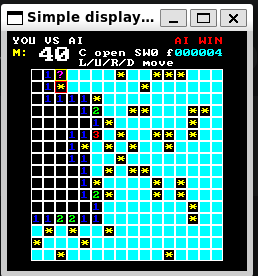
Minesweeper Solver FPGA
- Device: Digilent Nexys A7
- Language: C, Verilog HDL
- Peripherals: ST7789 (240x240 LCD), VGA, Buttons, 7-segment Display
This is a competitive Minesweeper game running on an FPGA board. A human player and an AI alternately open cells on the same board, and the side that opens a mine first loses.
The game logic runs on a RISC-V soft-core SoC based on CFU Proving Ground, and I added Verilog hardware for memory-mapped button input and 7-segment display output. The AI searches for safe cells using rule-based inference and risk evaluation. The system supports both ST7789 LCD and VGA output, and special cells add information asymmetry and turn-control mechanics.
GitHub RepositoryExperience
Experience
Aratama Factory
Website ↗I work on hardware development using FPGAs. Although the details of the work are confidential, I mainly contribute to development and design in the following technical areas.
FPGA development
Digital circuit design
Beamforming
Prompt engineering
Skills
Skills
Languages
- Verilog HDL
- SystemVerilog
- C / C++
- Python
- HTML / CSS
Hardware & FPGA
- Xilinx Artix-7 (Arty, Cmod)
- RISC-V Architecture
- Digital Circuit Design
- High-Level Synthesis (HLS)
- I2C / SPI / UART
Tools & Others
- Vivado / Vitis
- Git / GitHub
- Visual Studio Code
- LaTeX
- Linux